


Digital Media Issues post #3 – Tracking Innovation and Diffusion
Picture this: It’s 1994, the public internet has just hit the scene, www and https:// are all the rage, and bam – the QR code pops out of nowhere. And stays in nowhere-land until its popularization in mainstream spaces in the late 20teens and early 2020’s when its wide range of uses and seemingly never-ending unique configurations finally made sense to the general public (and marketers and phone companies – oh my!).
For an outline of the history, I recommend reviewing this article from Uniqode. As a brief synopsis, however, QR codes began their ideological start on the assembly line with the bullet-shaped, machine-readable code to maintain records for car manufacture progressions, and when barcodes later in mass consumption arenas (such as grocery stores, warehouses, and meat plants) were not housing enough data and were taking longer to be read.
1994 was the initial release of the QR code option – it could be read by any camera; however, it came with some functionality issues like angles or motion impeding cameras from taking the information. Over time, the frame around the QR code (short for Quick Response code) became more useable from a functionality standpoint.
We can see (just by nature of existing in the US for the last few years) that the QR has truly integrated itself into our day-to-day. From information about events, to recipes, to “what’s in that box again, dear?” to podcasts and news – the QR has staked its claim in a way hyperlinks could never 💅. My perspective on this wide-spread (and seemingly rapid) recent diffusion–a concept outlined and discussed by Everett M. Rogers in his article Diffusion of Innovations–would be its need during the Covid 19 Pandemic when it was no longer feasible to wipe every single menu down after someone so much as looked at it wrong (among other items that would often get frequent use for human information transfer–and by that I do mean communication). This adoption pattern closely resembles Rogers’ “collective innovation decision” model where a collective mass opts in favor of an innovation technology.
As Rogers notes, technologies occasionally do not take hold or struggle to maintain a hold on society due to multiple factors, particularly sociocultural. We can see in the early stages of the QR’s evolution that it was not popular immediately, in fact it took over 20 years for it to become “disruptive” as defined by Christensen et al. in their article What is disruptive innovation?, and thus commonplace in the United States daily experience. Once the “collective” identified the QR as a paradigm altering mechanism for connection in a dire moment of inherent societal separation and distancing, it was adopted willingly–almost overnight–by the population.
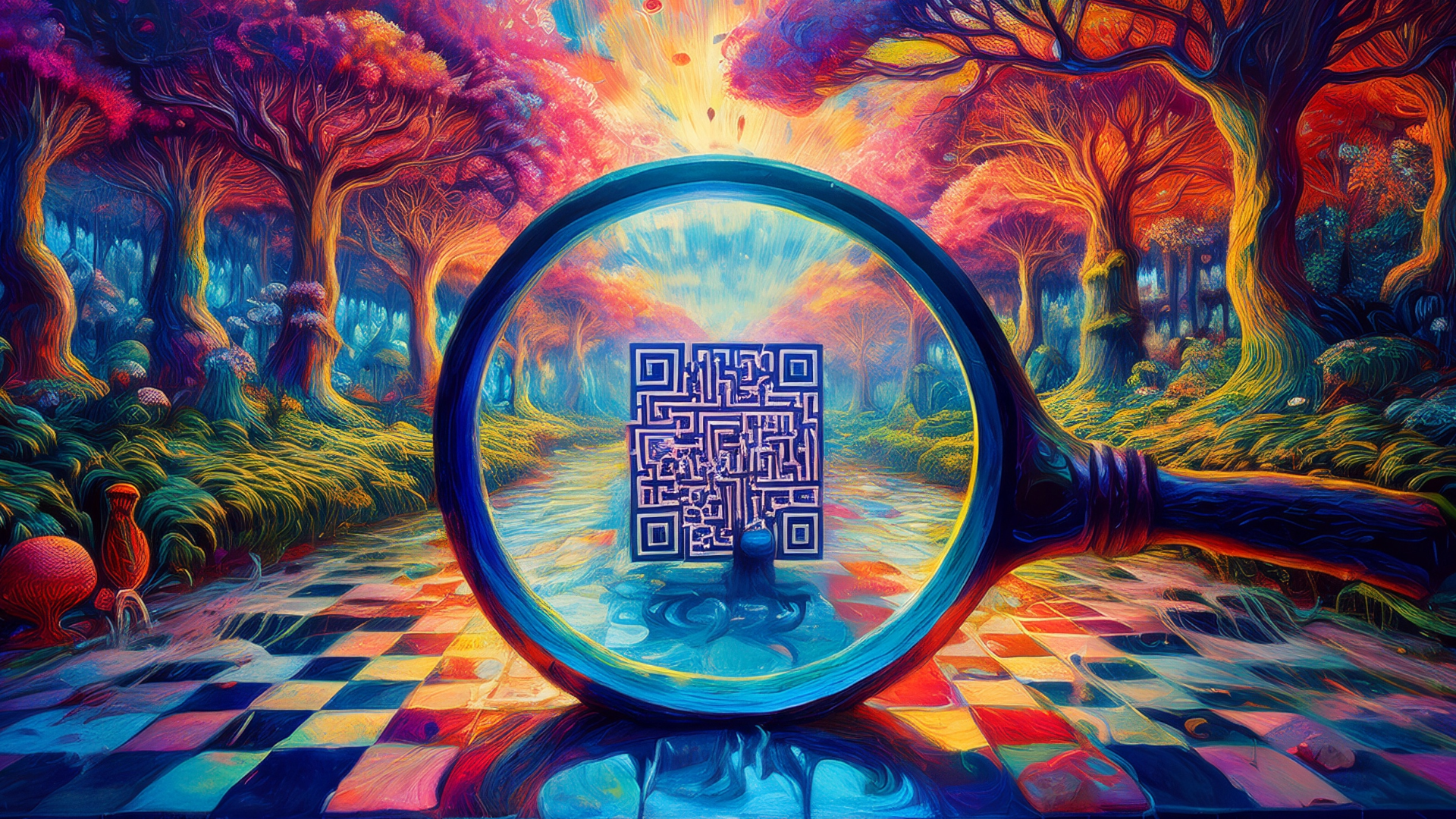
These days, we use the QR as a Hail Mary space saver on all things information media–a media made up of other media as McLuhan declares in Understanding Media: The Extension of Man (p. 10). “Scan to Learn More,” “Scan for Highlights,” “Scan to View,” “Scan for Tickets,” “Scan for Details,” “Scan for Instructions,” the list is endless. It is a way to instantaneously connect audiences to the meat-and-potatoes that won’t catch their eye on the initial view. The QR has now become an indicator of deeper understanding, increased excitement, and the looking glass through which we might experience a personal Wonderland.
 Sarah Wingfield
Leave a comment