

If you’re not familiar with Miyazaki’s Spirited Away, please treat yourself to one of the best, and weirdest films of all time.
If you’re not familiar with the concept of Transmedia Storytelling – you’re actually immersed in it every day. Even if you don’t like Star Wars, The Hunger Games, or any of the Marvel Movies – those are all transmedic franchises. Their lore fleshed out between movies, comics, television shows, audio stories, and even paratextually through promotional materials, interviews, and documentaries – these franchises build their cannon through intricate webs across media types.
Spirited Away is not traditionally transmedic, however, it lends itself well to practicing the art.
Spirited Away Theme Park
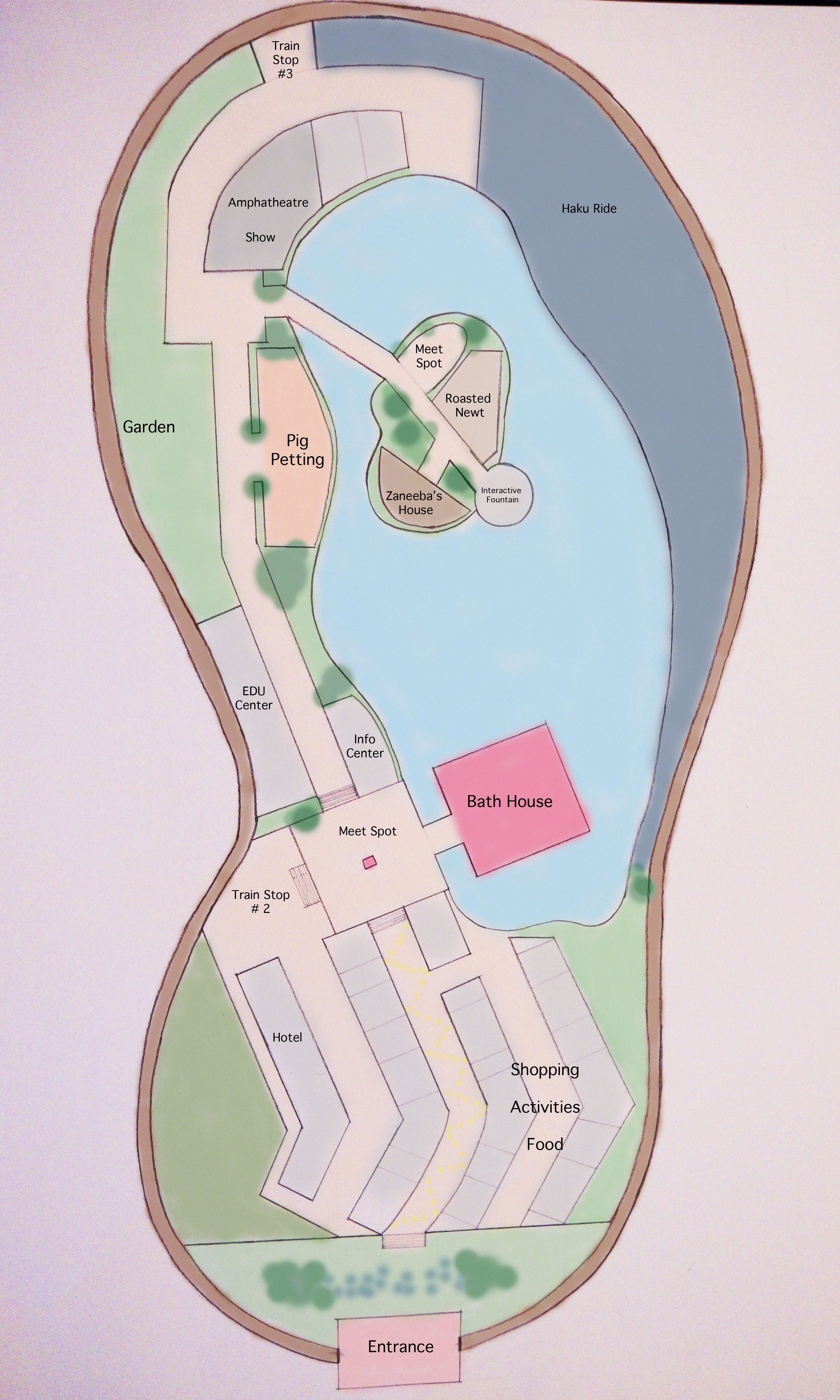
Our group chose to plan a theme park based on the Hayao Miyazaki film Spirited Away. Theme parks provide a safe playing ground for audience members by allowing them to explore and experience the narrative world without altering the course of said narrative. They also provide the opportunity to extend narrative through 4D rides and stage shows, while experientially extending the world via foods, sounds, smells, and environment. Not only does this type of transmedia extension have the potential for large profit simply through the nature of ticket purchase and merchandise sales, but it also promotes the overall franchise by creating excitement for the brand. Thus a theme park is an enticing addition to any narrative franchise. This type of extension is particularly apt for Spirited Away because the main setting of the narrative is a theme park. During the planning process there were several goals to achieve: transmediating pathos through immersion, extending the narrative, and building the franchise brand. This essay will focus on the first goal of immersing the audience in the world Miyazaki created and the thought processes behind it.
The initial instinct was to move full speed ahead to create a theme park, then the realization of what that meant settled in. The process of construction, function, and maintenance of such a complex means massive trauma for the ecosystems of Earth. This would be directly oppositional to the thematic structure of Spirited Away and Miyazaki films in general, which incorporate concepts of care for and appreciation of nature. The solution agreed upon is to engage in the use of sustainable construction and design techniques from conception to completion and beyond, in effect transmediating these important themes by reducing the carbon footprint of the park. Based on an interview with Craig Wingfield, a local architect with experience in theme park site planning, we discovered that there are many ways to minimize the wake of destruction this park would create. Some of these techniques include rehabilitation of a devastated or abandoned site, use of locally manufactured, photovoltaic, and recycled materials, storm water collection and retention, use of porous pavement to filter uncaptured water and prevent toxic runoff, biodiesel to power rides, recapture of energy produced by rides, selling locally grown and ethically produced food, and use of extensive recycling and composting programs along with many more detail-oriented techniques such as motion detection sensors for controlling lights and energy efficient fixtures. This wouldn’t be complete without educating visitors through signage and activities. To go one step further, we have incorporated this theme into the narrative extensions within the theme park, particularly in the show and ride which Kara and Natasha created.
The layout is based on the structure of the diegetic theme park. Because the story is set in a theme park, it lends itself well to transmediating pathos through physical immersion. Video games are famous for remotely creating a feeling of immersion and agency; theme parks have the opportunity to create an immediate viscerality to the immersion that games do not. The pathos generated by such a fully immersive experience is that of being in the imagined world of the film. While location and atmosphere may not transmediate narrative, it builds a strong connection between guest/audience member and the text. Drake McIntosh articulated in class his experience of Star Wars video games enhancing his connection with other extensions because he gained familiarity with the ships and their layout. Creating a real place to visit, in-person, allows fans to get as close and familiar with the details of the world as they choose. As mentioned above, the diegetic theme park is abandoned. This presents an obstacle in creating as realistic an experience as possible, but it was quickly dealt with by planning dual entrances to the businesses on the main street. The main street could then be closed during the day without the businesses losing any revenue, and the businesses could be open without tainting the guests’ immersion. This plan also conserves space and materials, reducing not only the carbon footprint during construction, but also the cost while insulating the guests’ experience. Upon entering, this path would feel empty, but further exploration would reveal exactly what Chihiro discovered – the vitality of the park. By creating an initial experience of that of the main character the transmediation of pathos is completed, just as Paul Booth discusses in his article Transmedia Pathos and Plot in The Walking Dead. In this article he explores how board games transmediate pathos by implementing the sort of motivations and emotions characters in a narrative would have.
Spirited Away is a text with such a rich, and small, setting that it would be feasible and rewarding to create a theme park extension. This theme park has the opportunity to not only create an immersive experience for the audience members, but it also maintains ethical standings of the narrative and brand of the franchise. It was designed to foster a deep connection to the narrative through which a connection to environment is encouraged, as well.
Works Cited
Booth, Paul. “Transmedia Pathos and Plot in The Walking Dead.” Game Play: Paratextuality in Contemporary Board Games. N.p.: Bloomsbury, 2015. 67-90. Print.
Wingfield, Craig. “Sustainability Within Theme Parks.” Personal interview. 25 Nov. 2015.
 Sarah Wingfield