
Digital Media Issues Post #9 Legal + Policies
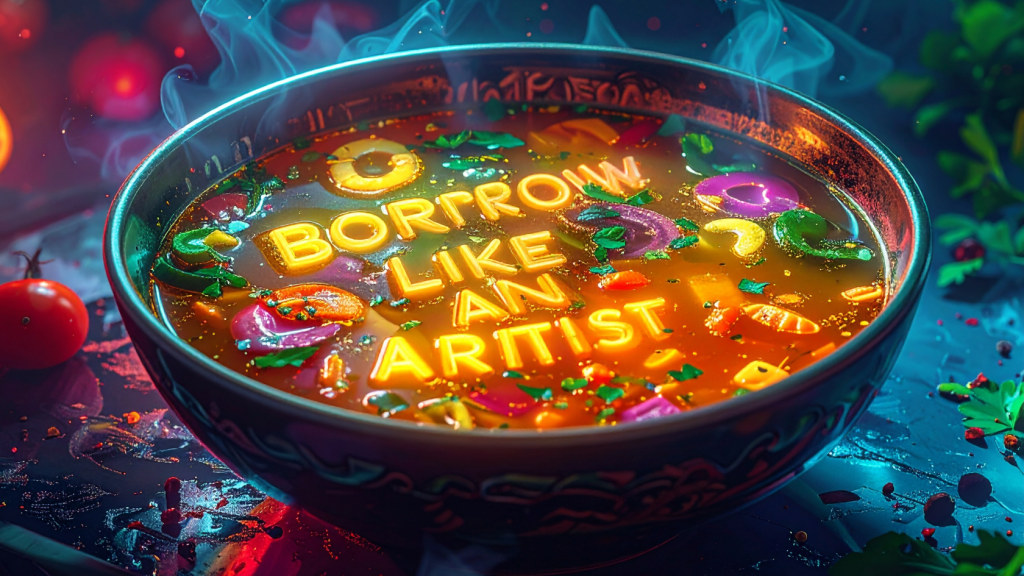
Steal Like an Artist, by Austin Kleon outlines the many ways in which artists “steal” ideas to repurpose them–the ever-useful “reduce, reuse, recycle” concept all creatives are taught at some point along their artistic development journey. Inevitably, a teacher or mentor will assign a project to “riff off” the work of another artist (usually famous, though not a requirement for this exercise). Low and behold: glorious, unique, and poignant pieces arise from the stolen stylization. But where does important inspiration and technical practice end and counterfeit reproduction begin?
This problem is numbers soup floating in murky pond water.
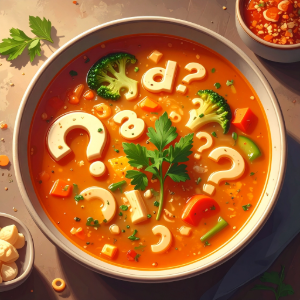
Another bowl of question soup is served up immediately:
- How do we prevent censorship, and still offer protection?
- Who is able to borrow?
- When is it considered stealing?
- Should creative work be an open market?
- What about creative assets?
- How do we even begin to go about this?
- How much money is enough for royalties?
- What credits will be required?
- Intellectual property vs Copyright?
- Music sampling?
- Photography use?
- Quotations?
- Fair use?
- Creative commons?
- What about screencapture?
- What about audio?
- What about likeness or vocal rights?
It’s endless..a murky stew I doubt we will ever begin to organize.
As cultures grow, change, and shift, new content platforms, use, and issues arise. How do we navigate limitations on reuse without stifling creative pursuits, and how do we incentivize creative production in a landscape where reuse is common practice? In other words: how do we stop the steal of creative works and intellectual property in order to protect those creators, while avoiding the oxymoronical Catch 22 of over-restriction such that creatives are not able to effectively work?
As they stand, current laws inhibit the creator from “perfect control” as noted by Lawrence Lessig (Code, 1999, p. 133). This allows other creators some leeway in repurposing sections of content within “reason” (in quotations because everyone will debate what that is exactly). However…many of these laws were created for physical content like books, hardware, paintings, tools, clothing, etc. How does the shift to digital impact these, especially with the growing use of AI?
“copyright has always been at war with technology.”
~ Lawrence Lessig
Lessig writes “copyright has always been at war with technology (Code, 1999, p. 123), noting the ease of reproduction, the natural result as technology develops, inherently and increasingly challenges copyright, and vice versa, specifically pointing to the printing press. As ease of reproduction increased…so did unethical copying.
With AI, open language models have relatively few boundaries – they can pull from any corner of the open internet, and so far…it doesn’t seem as though there are any rules or regulations on how these AI models cite their sources..it may be just so powerfully impossible to do – imagine having to cite every single word you choose in regular conversation. This is how I imagine AI would have to function if this were true.
Take a moment to also imagine all the creators, the researchers – their work is being shared as fact without any citation or credit. At the same time…the research that is behind a paywall is not even considered, so what kind of picture of fact is this crafting for the AI Era?
United States copyright laws do not currently cover facts, ideas, systems, or methods of operation – some of these uniquely born of human creativity and ingenuity.
[Loading…]
 Sarah Wingfield
Leave a comment